Information for Action
The living body
Chapter 1 · Health Information Systems
The routine health information system as the central nervous system of the district.
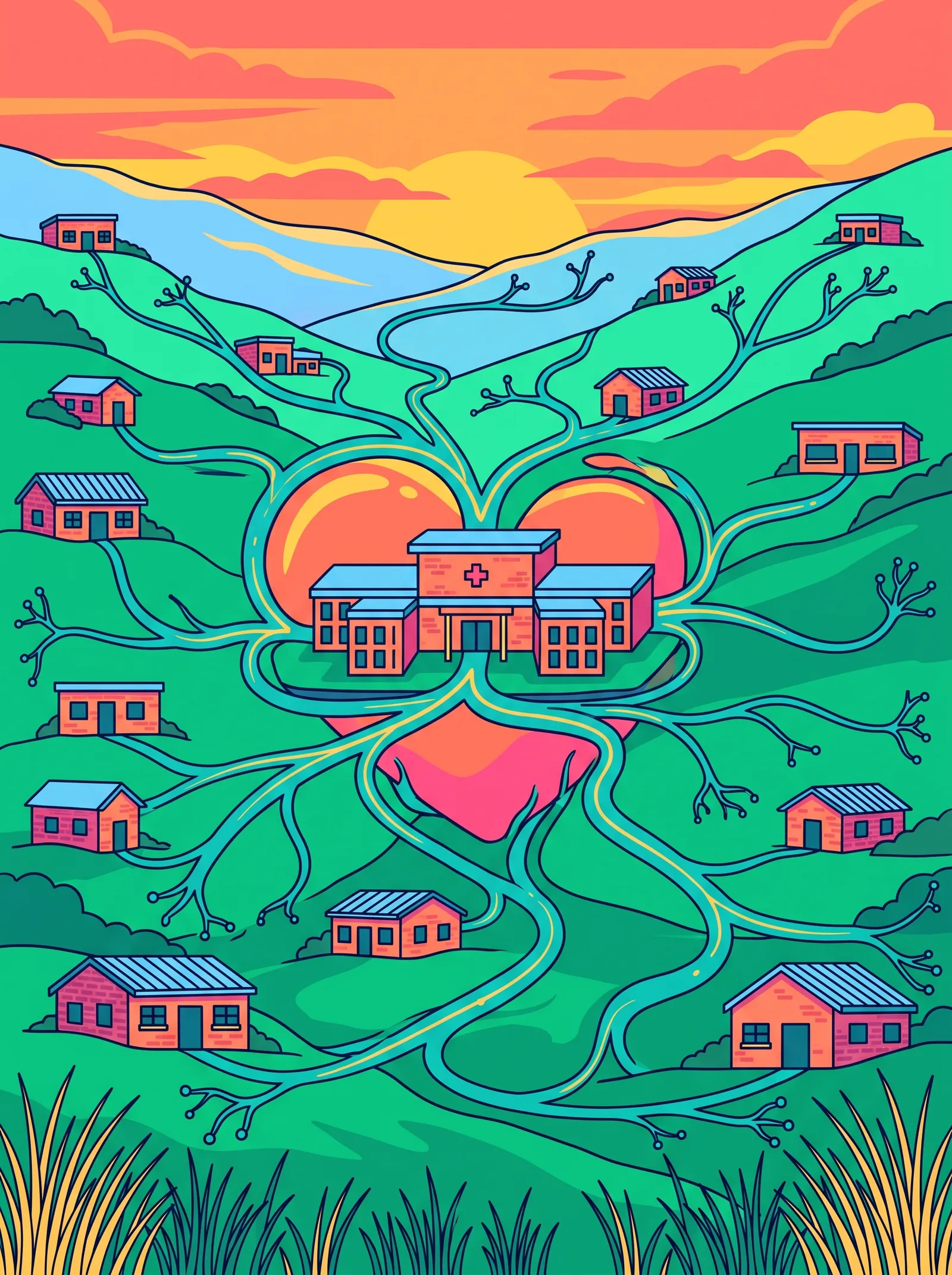
The Journey of a Signal, a five-minute film in a South African voice with captions. Watch it on the films page →
By the time you have read this chapter, you will be able to:
- Describe the Routine Health Information System (RHIS) using the "central nervous system" analogy of the district health ecosystem, identifying how it connects data collection to local action. Then map the data flow in your own catchment area.
- Apply the five RHIS principles (District-based PHC, Essential Data Set, Decentralised planning/monitoring/supervision, Inclusion of all providers, Interoperability) to assess strengths and weaknesses in your own context. Then identify one principle to strengthen locally.
- Identify "dangerous data" in your own system-data that are collected but never used locally-and propose a practical reduction in data burden. Then commit to a few specific data elements you could stop reporting or use differently.
- Use the six WHO building blocks (the "living body" analogy) as a diagnostic framework to identify which health system is the weakest component in your own facility or district. Then take one local action to strengthen that block using available resources.
Chapter overview:
This chapter introduces the foundational concepts of health information systems, with a focus on the Routine Health Information System (RHIS) as the engine of district-level data use. We explore the principles that guide RHIS design, the components that make it function, and the six WHO building blocks that constitute any health system.
By the end of this chapter, you should see your own facility or district not as a collection of separate programmes and problems, but as a living body-and the RHIS as its central nervous system.
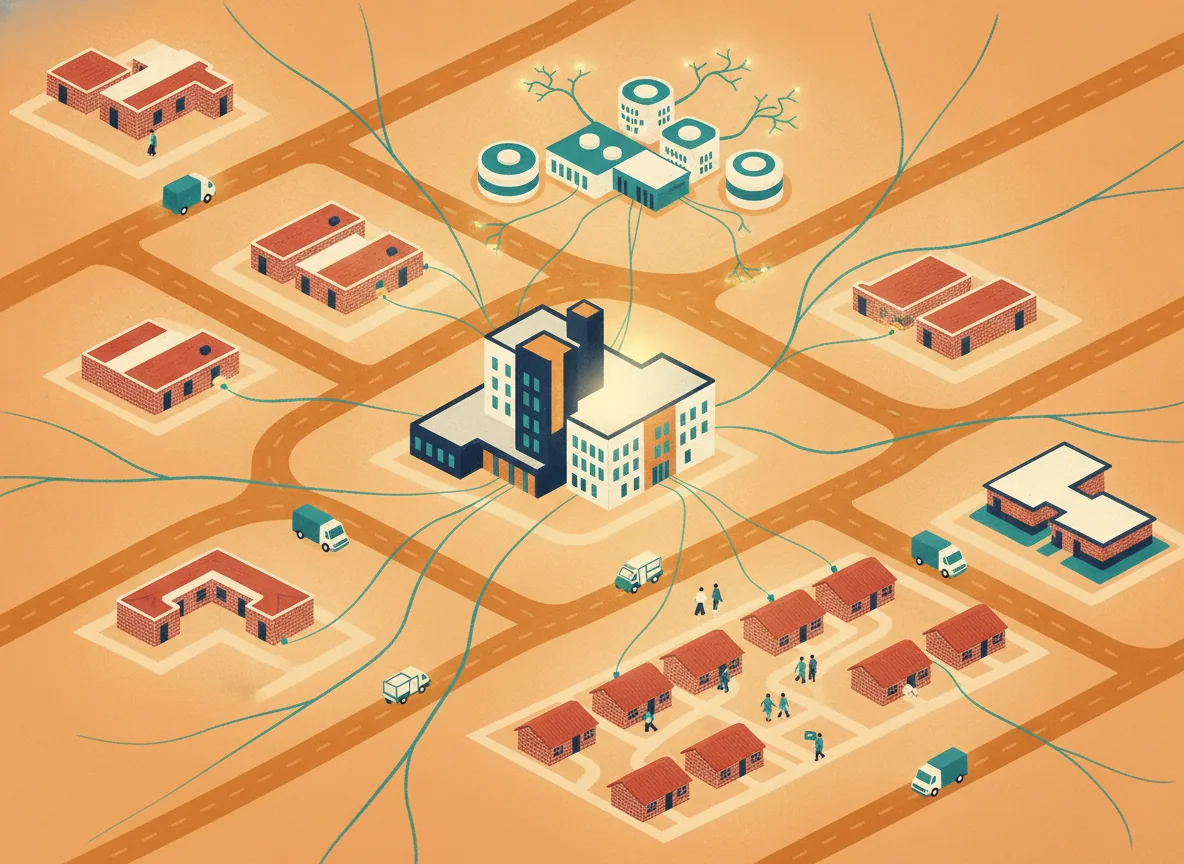
A health information system (HIS) is the massive, overarching structure that collects, processes, analyses, and transmits health data from all sources. it includes everything from patient records and disease surveillance to census data and health facility surveys. including patient records, disease surveillance, census data, and facility surveys but for the purposes of this manual, we focus on the part that affects daily management for districts: The routine health information system
2 The Routine Health Information System (RHIS)
The RHIS captures a wide array of facility data, from patient demographics and the services they receive to disease surveillance and other routine health indicators. while it can start with basic paper-based tools, its true potential is unlocked through even modest modern free open source technology for data collection, storage, and transmission. with artificial intelligence, its future is infinite.
Think of the Routine Health Information System (RHIS) as the central nervous system of the district's health ecosystem. It provides a continuous, integrated stream of information on all health-related activities. Its primary focus is the regular, systematic collection of essential health data directly from healthcare facilities. This isn't just about gathering numbers for a national archive; the RHIS is first and foremost a tool for local action. It is designed to empower local decision-making, helping facility and district managers understand their daily operations, track key health metrics over time, and ultimately improve the care they provide to their community.
As the primary data engine for the district data centre, the RHIS feeds and supports all other district-level information systems. This includes data from primary health care (PHC) services, district and provincial hospitals, notifiable disease registers, vital events (births and deaths), transport, logistics, environmental health, and laboratory services.
In short, its scope is comprehensive, covering every facet of the district health system.
The RHIS vision is a future where routine data drives routine action: every facility manager leads a team that confidently reviews high-quality monthly data to assess performance, celebrate successes, identify gaps, and act immediately with local stakeholders.
This same data flows upward to give provincial and national leaders an accurate picture of ground-level realities, while the system itself rapidly transforms from cumbersome paper registers into a fully integrated digital hub-connecting RHIS with vital registration, pharmacy, finance, and personnel data.
The result is a powerful, accessible database of all district health activities, enabling managers at every level to translate policy into practice, hit annual targets, and build the heart of a data-driven health system.
1.1 Routine HIS principles
The following five principles transform an RHIS from a passive reporting burden into an active management tool, shifting focus from national donors to local managers and frontline teams. Each principle guards against the most common pitfalls: information overload, top-down planning, fragmented systems, and siloed stakeholders
1.1.1 Supports the district-based PHC approach
The District Health System (DHS) is the operational arm of the Primary Health Care (PHC) approach. It empowers managers at the district and facility level to deliver comprehensive, integrated services to a defined population. The RHIS is built to support this decentralised model. It provides a practical set of tools, a local information system, that enables District Health Management Teams (DHMTs) to monitor services effectively. By putting actionable data in the hands of local managers, the RHIS helps them allocate their limited resources where they will have the greatest impact. and allocate limited resources where they will have greatest impact
1.1.2 Collects essential data based on indicators
An information system can easily become a burden if it demands too much data. A good RHIS guards against this by focusing strictly on “must-know” information. This core is the Essential Data Set: a carefully selected list of the most important data elements from all PHC programmes. Its purpose is to generate the key action indicators needed to monitor health services in an integrated way. This focus is crucial: it gives health workers a clear and manageable picture of their monitoring priorities. This Essential Data Set is not set in stone; it is reviewed regularly (annually) to ensure it stays relevant to current needs. Any information that doesn’t inform local management decisions is promptly dropped at an annual review.
For example, Dangerous data for Immunisation: The single “must-know” indicator might be Measles 1st dose before 12 months coverage. However, it’s easy to get sidetracked by other “nice-to-know” data, like gender and location of immunisation. While useful in some contexts, this extra data is often of little direct use to a busy clinic team. This is what we call “dangerous” data, not because it’s incorrect, but because it distracts health workers from their primary task of seeing patients and diverts their attention to information that won’t help them make a better decision today. This “dangerous data” also uses resources like people, time and equipment with no return; there is no value created for this data.
A cautionary tale: One province initially pared its essential data set down to a lean 40 data elements to create 26 indicators. Over time, as donors and managers requested more and more "useful" indicators to measure quality, it ballooned to over 500 items and 300 indicators. This volume is impossible for any single facility to analyse effectively, forcing managers back into the difficult position of needing to prioritise the most important action indicators.
1.1.3 Encourages decentralised planning, monitoring and supervision
The RHIS is designed to fuel a continuous cycle of local action: planning, monitoring, and supervision. This is a recurring theme throughout this manual and is extensively covered in Chapter 9.
Planning: Ideally, planning should be a bottom-up process fed by local needs, with facility-level plans, grounded in their own RHIS data, aggregated into district plans, which then inform provincial and national strategies. In reality, most planning systems are top-down and fed by national and donors' desires rather than the needs of facilities and communities.
However, Facilities and districts should set their own priorities and, as part of their planning, select a set of locally relevant Action Indicators, even within a national framework.
Monitoring: This is the process of tracking progress against those selected action indicators. The RHIS empowers local managers to select a small, manageable set of action indicators (also known as Key Performance Indicators-KPIs) that directly reflect their priority service issues. By regularly monitoring these self-selected action indicators, they can quickly see if their activities are on track to meet locally-set targets.
This is the heart of an action-oriented decentralised information system.
Supervision: Armed with the same set of action indicators, managers can identify which reporting units (wards, facilities) are excelling and which are struggling. This transforms supervision from a fault-finding mission into a supportive dialogue, most of which can be conducted remotely. Managers can sit down with peripheral staff, discuss the challenges revealed by the data, and provide the targeted support needed to improve performance.
The insights gained from monitoring and supervision then become the foundation for the next planning cycle, creating a virtuous, data-driven loop for continuous improvement.
1.1.4 Includes all service providers and stakeholders
In a digital world, information is meant to be shared between multiple stakeholders. The RHIS is built on this principle, creating a transparent and useful picture of community health that keeps everyone interested and informed.
The "team" contributing to and benefiting from this system is broad. It includes all service providers, from public clinics, district hospitals, and provincial facilities to private practitioners, mobile clinics, and even traditional healers. Crucially, it also includes community stakeholders and various health-related organisations, ensuring that the system reflects the full spectrum of care.
1.1.5 Interoperable with other information systems
At its core, this principle means that the RHIS is not an island (see Chapter 11). It is designed to seamlessly connect and share data with other critical information systems, like those for finance, logistics, and human resources, through the national database, creating a unified and powerful health intelligence platform.
1.2 Routine HIS: Integrating components and systems
The RHIS consolidates facility, personnel, epidemiology, intervention, and financing data into a single, unified Health Information Exchange (HIE). Quality control, feedback, and reporting flow through this HIE, turning raw data into actionable insight as described in Chapters 5 and 11.
Health Facility & Personnel Data: The Facility Profile (infrastructure, staff, equipment) merges with HR data (skills, deployment). District managers use this integrated view to match workforce to service demand and resource gaps.
Epidemiology & Public Health Interventions: Morbidity, mortality, and outbreak data are linked to programme performance (immunisation, HIV/TB, malaria, maternal health). This integration enables early outbreak warnings and real-time course correction of interventions.
Health Financing: The District Health Expenditure Review (budgets, spending) connects directly to service and outcome data. Managers can track whether resources drive health gains, supporting accountable reallocation.
Feedback to Data Providers: Dashboards, supervision visits, and review meetings close the loop, showing frontline staff how their data triggers action. This turns reporting into a management tool.
Integration of technical systems:
Health Information Exchange (HIE): Two-way data flow upward (to provincial/national levels) and downward (feedback to local facilities, partners, researchers). Ensures that local data inform policy and vice versa.
Data Quality & Management: Automated validation, error correction, and standardised protocols govern storage, security, and privacy. Good data enable confident decisions.
ICT Integration: Electronic health records (EHRs), HMIS platforms, and mHealth tools are linked for interoperability. Real-time capture and analysis replace siloed, delayed reports.
Outcome: By bringing these components together, the RHIS becomes more than just a database. The RHIS becomes a foundational tool for planning, monitoring, supervising and evaluating health interventions, addressing disparities and promoting health equity, all at the local level where it matters most.
1.2.1 The health management information system (HMIS)
If the RHIS is the peripheral nervous system, the Health Management Information System (HMIS) is the brain. It is a specialised subset of the overall HIS, designed specifically for the needs of healthcare managers and administrators. While it draws its core data from the RHIS and supplements it with information from national databases for governance, human resources, finance, and logistics, its key focus is different:understanding data through systematic analysis.
The HMIS is equipped with powerful tools and software to process, analyse, and visualise health data, transforming raw numbers into indicators that power insightful reports, dashboards, and summaries. It uses standardised reporting templates to track KPIs and other performance metrics, helping managers to monitor progress and make strategic decisions about resource allocation, programme evaluation, and long-term planning.
A robust HMIS also has internal tools to monitor its own performance, data quality, and overall functionality. It includes evaluation mechanisms to assess its own impact on health service delivery and outcomes. Above all, its success depends on people. Training and capacity building is a core component, with a suite of online materials, user manuals, and workshops designed to equip district health staff with the skills to use the HMIS effectively.
In summary, the overall HIS (central nervous system) provides the complete picture of all health-related data. Within that, the RHIS (peripheral nervous system) is the workhorse, focused on the routine collection and reporting of operational data from facilities. The HMIS (brain) is the strategic command centre, a subset of the HIS that uses more sophisticated tools to analyse that data and support high-level managerial decision-making. Together, they form an integrated framework that drives improved health service delivery, smarter planning, and more effective supervision at every level.
1.3 Health system building blocks
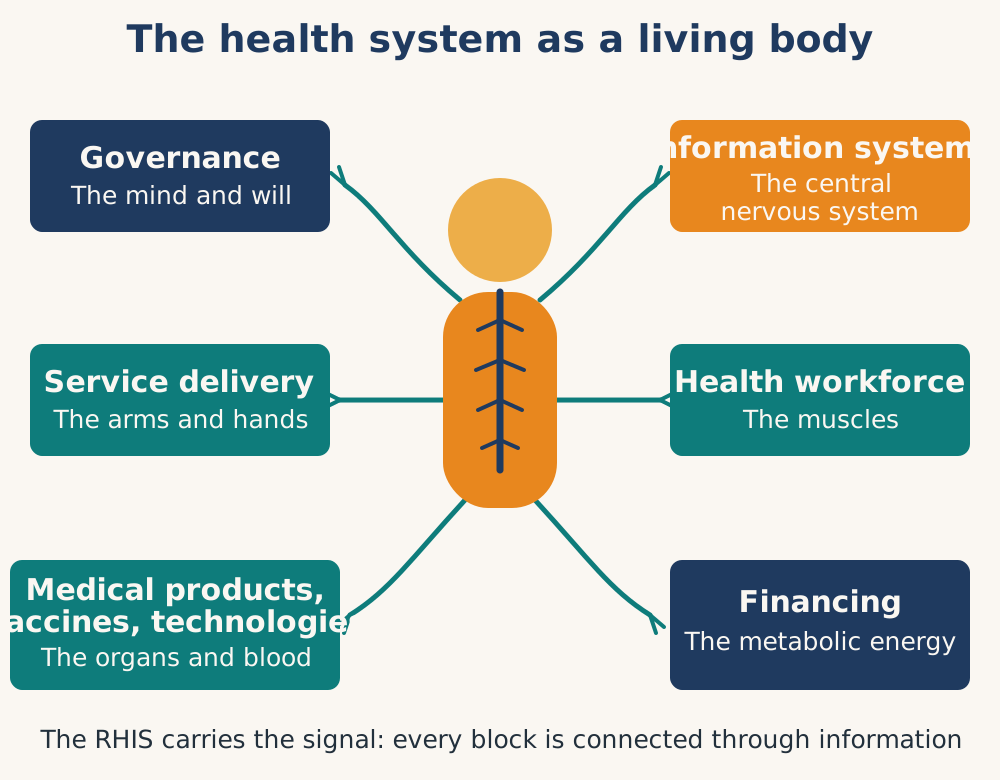
The health system building blocks ... the living body of health
Imagine a health system not as a bureaucratic chart on a wall, but as a living, breathing body. Its purpose is singular: to improve health. This health system “body” is a vast, interconnected organism; a collection of organisations, institutions, resources, and people working in concert. It extends its reach from influencing the very air its community breathes (the determinants of health) to the most delicate, life-saving interventions within a hospital’s walls. At its heart lies the Primary Health Care (PHC) system, the body’s circulatory network, delivering preventive, promotive, curative, and rehabilitative care through a combination of public health actions and a pyramid of facilities, all staffed by a mix of State and non-State actors.
For this body to stand, let alone walk, it needs a skeleton of staff, the lifeblood of funds, a nervous system of information, the muscle of supplies, the limbs of transport, the voice of communications, and the wisdom of overall guidance. Strengthening a health system, therefore, is an exercise in physiology: it means routinely checking the pulse of each of these critical components to identify and address the constraints that cause a limp, a stutter, or a fever.
The Health Information System (HIS) is not a separate entity; it is the body's central nervous system. It is a complex, intricate network that doesn't just exist for itself. Its sole purpose is to collect, analyze, and interpret the signals from every other part of the body, allowing the whole organism to sense, understand, and act.
This handbook uses the World Health Organization (WHO) framework-a kind of anatomical map- that identifies six essential building blocks, the vital organs that keep the system alive and thriving. Let's take a tour of this living body.
1.3.1 Service delivery: The arms and hands
This is where the body touches the world, from the nimble fingers of a community health worker in a village to the powerful, specialised grasp of a tertiary hospital's surgical team. These arms deliver preventive, promotive, curative, and rehabilitative services to a defined catchment area. Their mission is to ensure that no matter who you are or where you live, those hands can reach you, providing quality care and tending to the community's diverse needs while working to heal the deep disparities that cause inequity.
Our central nervous system (the HIS) collects routine data from every movement of these arms and hands-every patient seen, every vaccination given, every procedure performed is collected. This stream of signals forms the very foundation of the routine HIS, telling us where the body is most active and where it might be overstretched. The HIS collects data from every movement: every patient seen, every vaccination given.
1.3.2 Health workforce: The muscles
If service delivery is the arms, the health workforce is the muscle that gives them strength. These are the doctors, nurses, midwives, pharmacists, and community health workers-the dedicated cells that power every action. For the body to function, these muscles must be the right number (neither too few to lift the load, nor too many to coordinate), correctly distributed, competent, motivated, and retained.
The HIS must measure the health of these muscles: their training, their regulation, and the support systems that prevent fatigue. The HIS tracks the condition of these muscles through stand-alone human resource systems, the body's muscle-fiber registry, which integrates with the RHIS in the central nervous system's command (national database).
For a deeper health check, we rely on surveys such as the three-yearly Barrets surveys (like an MRI for muscle integrity) and the Kantor staff satisfaction survey (which tells us if the muscles are aching or strong).
1.3.3 Health information systems: The central nervous system
Here is the overarching system that ties everything together. It manages the collection, analysis, and use of health data to support decision-making. This includes everything from paper records to electronic health records, disease surveillance (the body's pain receptors), vital statistics (the heartbeat), and health registries (the memory). A reliable HIS provides timely, accurate data so the body can monitor its own vital signs, evaluate whether a treatment is working, and plan its next movement. Remember that the Routine HIS, the focus of this manual, is a major nerve tract within this larger nervous system, constantly integrating data from parallel systems into the national database, where it becomes accessible to every level to measure key performance indicators and manage the body's functions.
The overarching system that ties everything together, managing collection, analysis, and use of health data. The RHIS is a major nerve tract within this larger nervous system
1.3.4 Medical products, vaccines, technologies: The organs and blood
This building block represents the internal organs and the lifeblood that sustain all activity. It ensures access to essential medical products, vaccines, and technologies. It encompasses pharmaceuticals, medical devices, diagnostic tools, and immunisation supplies. Without safe, effective, and affordable access to these, the body's most powerful muscles and its most sophisticated nervous system are useless.
The health of these vital organs is monitored by a number of (normally stand-alone) dedicated surveillance systems. Its findings, too, are integrated into the national database, ensuring the central nervous system is constantly aware of any organ failure or shortage in the blood supply.
Essential medical products, vaccines, and technologies: the internal organs and lifeblood. Stand-alone surveillance systems monitor their health, with findings integrated into the national database
1.3.5 Health financing: The metabolic energy
Just as a body requires energy to function, the health system runs on financial resources. Health financing is the metabolic system, the mobilisation, allocation, and utilisation of energy from various sources: taxation, social health insurance, private insurance and out-of-pocket payments, and donor funding. Effective health financing aims for a balanced, efficient metabolism that provides financial protection, equity, and sustainability, all to achieve the ultimate goal of universal health coverage.
We track the body's energy flow through a variety of financial systems, again made visible through the national database. The system's overall metabolic balance is then rigorously audited annually by the Auditor General, a kind of full-body metabolic assessment.
The mobilisation, allocation, and utilisation of financial resources from taxation, insurance, and donor funding. Tracked through financial systems and audited annually by the Auditor General
1.3.6 Leadership and governance: The mind and will
Finally, none of this functions without a mind to guide it. Leadership and governance provide the strategic direction, management, and oversight. This is the brain setting the rhythm, forming policy, the organisational structure, the accountability mechanisms and the body's social connections. Strong governance ensures transparency, equity, and responsiveness, fostering the trust that is the very spirit of the system.
The health of the "mind" is harder to quantify and is usually the most poorly monitored system as good indicators are difficult to identify. We measure its outputs indirectly by looking at financial indicators from the Auditor General's Report, the HR Barret survey, the approved post lists, and essential drug stockouts.
These six building blocks-the arms, muscles, nerves, organs, energy, and mind-are not separate. They are intimately interconnected. A failure in one is a weakness in all. A weakness in the metabolism (financing) starves the organs (medical products). A failure in the mind (governance) leads to poor planning, confused muscles (workforce) and ineffective arms (service delivery).
Strengthening a health system, therefore, is about strengthening this entire living body. And for the body to be resilient, effective, and high-performing, its central nervous system-the RHIS-must collect high-quality data on all six of its vital organs. Only then can it measure its own health, diagnose its own ailments, and act with the precision and wisdom needed to achieve its ultimate purpose: improving health outcomes and promoting health equity for all.
These six building blocks are intimately interconnected. A failure in one weakens all. The RHIS must collect quality data on all six for the body to be resilient and effective
1.4 Plan, do, study, act: PDSA turns information into action
You have identified the problem. You have asked "But why?" three times. You have found the root cause. Now what?
This is where most health managers stop. They know what is wrong, but they do not know how to fix it. Or they know how to fix it, but they wait for permission. Or they try something once, it does not work, and they give up.
PDSA, Plan, Do, Study, Act, is the engine that turns information into action. It is a structured way to test a small change, see if it works, and either keep it, adapt it, or abandon it. No expensive consultants. No lengthy approvals. Just a simple cycle of local learning by doing simple actions and documenting what happens.
The principle is simple: start small. Pick one off-target indicator. Make one hypothesis about what will improve it. Test that hypothesis with one action in one facility for one month (or even one week). Then study what happened. If it worked, spread it. If it failed, ask “But why?” again and try something else.
PDSA turns a one-off action into continuous improvement. It transforms routine data from a rear-view mirror into a steering wheel. And it gives managers permission to act locally, not perfectly, but purposefully.
The table below outlines the four stages. The details are in Chapters 8 and 9. Use it as your guide. Start today.
| PDSA Method | |
|---|---|
| Stage | Action |
| Plan | Identify the off-target indicator. Ask “but why?” three times. Make a hypothesis. Write one small, feasible action |
| Do | Identify who will do what, by when, and how. Implement immediately – no waiting for permission. |
| Study | At next month’s self-assessment, compare the indicator’s new value to the old value. Did it improve? |
| Act | If it worked, make the action permanent. If it failed, discard it, refine your hypothesis, and try a different action. |
1.5 Summary for managers: Actions you can take tomorrow
| Health Centre Manager | Identify “dangerous data" you collect but never use. Collect data, but stop reporting it for three months. See who notices. |
|---|---|
| District Manager | Pick one facility with interested staff. Discuss with them to identify their weakest building block. Help them find one local action to strengthen it through PDSA, no extra budget required. |
| Policy/ Decision Maker | Send a one-page feedback report to each district in your catchment area. Not a spreadsheet. A story with one graph. Ask them to reply with one thing they changed because of it. |
Capstone exercise: Your facility as a patient
Task: Pretend your facility or district is a patient that has come to you for a check-up. The "patient" (your health system) is complaining of fatigue and poor performance.
Using the six building blocks, conduct a rapid diagnosis:
Service Delivery (Vital signs): What is one indicator that shows how fast or slow the system is moving?
Workforce (Muscle strength): Is one muscle group overworked while another is underused?
Information (Nerve function): Are the signals from the nerves reaching the brain? Or are they getting stuck in the spine?
Medical Products (Organ health): Is the heart (essential drugs) beating regularly, or are there skipped beats (stockouts)?
Financing (Metabolism): Is the body burning energy efficiently, or is it leaking fuel
References
- World Health Organization, 2023
- World Health Organization, 2024
- World Health Organization, 2024
- World Health Organization, n.d.
- MEASURE Evaluation, n.d.
- Unknown, 2010
- Lippeveld, 2000
- World Health Organization, 2023
- Routine Health Information Network (RHINO), n.d.
- UNHCR, n.d.