Information for Action
Skeleton and muscle
Chapter 8 · Data Stewardship
Governance is the skeleton; stewardship is the muscle that makes it move.

This chapter focuses on the “why” and “who” of implementing data stewardship by the district, the roles, the culture, the change management, and how to monitor stewardship itself.
All step-by-step practical content (meeting agendas, templates, PDSA worksheets) is in Chapter 9.
By the time you have read this chapter, you will be able to:
- Explain why top-down governance fails and how decentralised stewardship repairs the three broken processes of planning, monitoring, and supervision.
- Prepare a district readiness checklist and a 90-day change management roadmap before implementing any stewardship action.
- Distinguish between data owners, data custodians, and data stewards, and identify who is missing in your own context.
- Apply the supervision ladder (Levels 1 to 3) to decide when to use remote support and when to make an in-person visit.
- Monitor stewardship itself using process indicators and a simple dashboard, not just clinical outcomes.
Introduction: Why this chapter exists
Your district has data policies. You have detailed data-related job descriptions telling you who is supposed to do what and glossy SOPs telling you what to do when you receive data. You have a beautiful organogram showing exactly who reports to whom by when. So why is your data still not used?
Because governance alone is a skeleton. It has bones but no movement. What you are missing is the muscle, the daily, weekly, monthly human actions that turn high level policies into habits, quality data into decisions, and reports into results. That muscle is stewardship.
Now let us walk through the journey. First, we look at the three broken processes that make stewardship necessary. Then we define stewardship and show why top-down governance always fails without it. After that, you will learn how to prepare for stewardship, how to manage the change, how to monitor whether your stewardship system is actually working and finally, strategies to put the information cycle into action.
8.1 The three broken processes: No surprises here
Every district officer knows these three universal problems. They are not new; they are just never solved together.
Planning is made in the national office. Sometimes district staff are consulted, but usually not. The plan sits on a shelf after March. Facilities have never seen it. The indicators in the plan have no relationship to the indicators in the monitoring forms.
Monitoring is done because the ministry demands it. Every month, facilities fill forms and send them upward. Nobody at the facility stops to ask “What do these numbers mean for us?” It is mechanical, joyless, and produces data but not insight. There is no feedback, so nobody ever learns the importance of their own data.
Supervision arrives once a quarter (often on market days). A supervisor checks the fridge temperature, the cleanliness of the delivery bed, and whether the register is signed. They never look at the facility’s own data. They never ask why malaria tests dropped or what the antenatal coverage is. They leave with no feedback. Nothing changes.
The cost of keeping these three separate is that the same frontline worker sees no connection between the annual plan, their monthly report, and the supervisor’s visit. Three different processes, three different sets of indicators, zero learning, zero action.
Stewardship is the repair kit.
8.2 What is stewardship, really?
Let us start with what stewardship is not. It is not central control, not filling out forms on behalf of facilities, not begging the capital for permission, and definitely not another monotonous meeting of managerial monologues .
Governance in data management is the skeleton: the development of policies, procedures, job descriptions, and organograms. It answers who does what, when, and by what rules?
Stewardship is the muscle: the active, ongoing human responsibility that makes governance work. The team that puts the policies and plans into practice so that the system benefits the health workers and the community
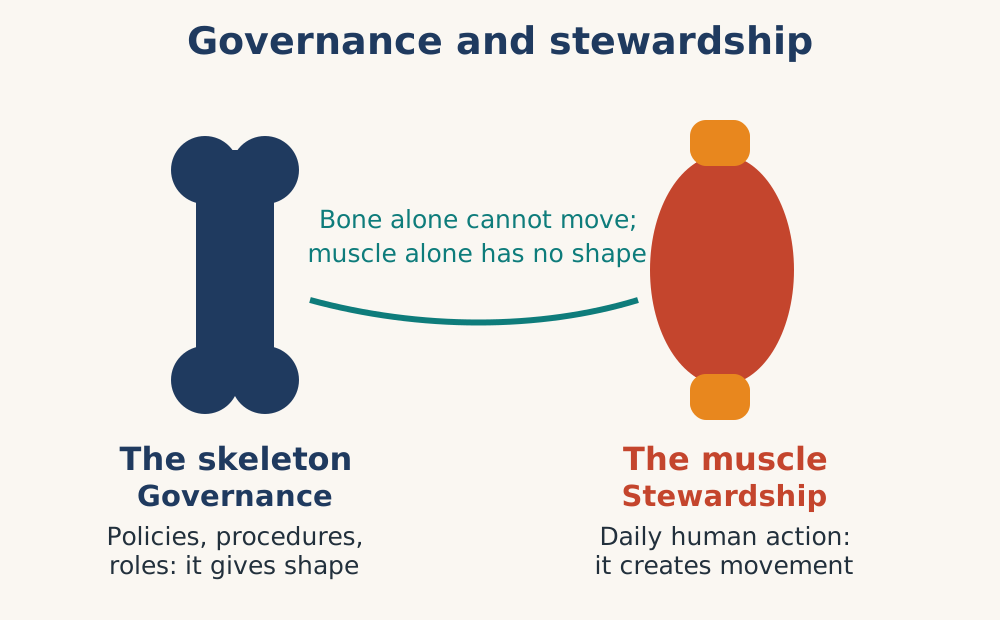
Where governance says “thou shalt use data for supervision,” stewardship says “What can I learn about this facility from their data and indicators before I visit”
| Question | Governance | Stewardship |
|---|---|---|
| Who is responsible? | Give the job description. | Demonstrates leadership that motivates action |
| What are the rules? | Write the policy. | Knows when to follow the rules and when to call for a sensible exception. |
| How do we know it is working? | Set the performance metrics. . | Looks at the metrics, tells a story, and takes action |
Our stewardship definition for districts: The active, ongoing activities of the district health management team to ensure institutionalised analysis and use of the same indicators for planning, monitoring, and supervision, so that information becomes action at the periphery.
A steward does not just know that data should be accurate, they check the registers.
They do not just know that feedback should happen, they make the phone call.
They do not just know that indicators should be aligned, they sit with the facility and negotiate the 10 most important and useful ones.
Why top-down governance fails
Policies written in the national office rarely survive contact with the clinic floor. Here is why.
National policies cannot foresee every local stockout, staff shortage, or seasonal malaria spike; they are written for an ideal world that does not exist.
When a policy written by “experts” and donors is handed down without negotiation, facilities feel no responsibility to follow it; it becomes someone else's rule to break.
Governance rarely includes a mechanism for the periphery to report back on what is not working, so problems fester because no one at the top hears about them.
Supervisors become inspectors checking compliance, not coaches solving problems, and staff learn to hide failures rather than fix them.
Finally, the same indicator set is used for a busy urban clinic and a remote rural post, making the data meaningless for both.
The result is policies that sit in binders, procedures that are forgotten, and an organisational structure that exists on paper but not in practice. Governance without stewardship is a machine with no operator.
Data management roles are often confused. Here is the simplest way to separate them.
| Data Steward vs. Data Custodian vs. Data Owner | ||
|---|---|---|
| Role | Responsibility | Example |
| Data owner | Decides what data are collected, who can access them, and for what purpose. A senior manager or programme director. | The head of the HIV programme decides that CD4 counts must be reported monthly. |
| Data custodian | Manages the technical infrastructure, servers, databases, security, backups. Usually an IT officer. | The database administrator ensures the server is backed up every night. |
| Data steward | Ensures the data are fit for purpose, accurate, consistent, available, and used for action. Usually a manager at district or facility level. | The district coordinator notices that malaria tests have dropped for three months and calls the facility to ask why. |
In the district PHC context, the data steward is the missing link. Owners are too high, custodians are too technical, whereas stewards are right where the action is.
8.3 The five stewardship actions: Why they matter for RHIS
You have the skeleton (governance) and want to develop the potential muscle (stewardship).
Now it is time to prepare for the daily, weekly, monthly actions that will transform your district.
But before we dive into implementing the five stewardship actions, let us be clear about these particular actions, why they are at the core of any successful district and why they will outlive any single manager, any donor project, any change of government.
The spirit that drives the actions
Action indicators that change everything
Without indicators, managers can not function. Routine data can not answer any questions, facilities can not understand what reports mean, programmes can not analyse their information and supervision is a random walk. With indicators, data is converted into information, self-assessment becomes possible, programme managers can see patterns and take action, supervision becomes targeted.
With a few well selected action indicators, data is converted into information, self-assessment becomes possible, programme managers can see patterns and take action, supervision becomes targeted.
The team pulls up the last months of data, calculates the facility’s ten action indicators, visualises them to see patterns, and identify stories. A deep dive asks fundamental “but why” questions about problem indicators, your self-assessment said stockouts, but your stock report shows supplies. What is really happening?” How can we improve? These questions could never be asked without the indicators.
These questions could never be asked without the indicators.
Empowerment through facility self-assessment
Facilities should analyse their own data every month. Not for the district. For themselves. To see what went well and congratulate themselves. To see what went wrong and fix it before more harm is done.
Self-assessment unlocks enormous hidden skills at facility level. The laboratory technician with a passion for numbers. The driver who loves computers. The nurse with untapped mathematical talent. With good mentorship, each of these people will contribute and walk out empowered. You already have the talent pool. You just have not asked them to use it.
At the facility, no additional resources are required except dedicated time for the information team and some snacks to keep the brain cells nourished. The necessary computer, internet, flipcharts, blackboards should already be there. If not, then this is a good opportunity to upgrade.
Self-assessment is exactly what it sounds like: interested members of the facility team, nurses, managers, data clerks, sometimes the driver, sit down with their action indicators and a structured approach and ask themselves hard questions about their own performance. No external supervisor with a clipboard. No surprise inspection. Just the people who work there, looking at their own data, their own processes, their own gaps, and their own wins.
The self-assessment is tailored to the needs of the facility and scaled to its size. A small dispensary with two staff and no computer will not have the same action indicators as a large health centre with in-patient beds.
The literature calls this many things, “self-audit,” “self-evaluation,” “internal assessment”, but the core idea is consistent: facilities become the agents of their own improvement, not the passive recipients of external judgement. Self-assessment has been used successfully for decades in clinical quality improvement, patient safety, and hospital accreditation. The evidence is clear: when facilities assess themselves honestly and regularly, performance improves.
But here is the gap. There is almost nothing in the literature about self-assessment for routine health information systems. No articles. No validated tools. No guidance on how a facility should look at its own data, the data it already collects every day, and use that reflection to change behaviour. This chapter fills that gap.
Quarterly review: Spreading curiosity
You probably already have quarterly meetings of district and facility heads that are boring and bland, monotonous managerial monologues about single vertical programmes only worth attending for the (donor supplied) lunch.
Just change the agenda. Stop reviewing administrative trivia and wasting time assessing data quality without using the data. Start reviewing the ten action indicators and get facilities involved in using RHIS data to monitor the bigger picture.
There will always be resistance to change. Changing the focus of the meeting requires a combination of diplomacy and forceful persuasion, a good story for a sales pitch, and the promise of an interesting outcome for all stakeholders.
The DHMT and facility heads are central, while programme managers, key stakeholders, and community representatives should all contribute. Anyone with enthusiasm for information is welcome.
The annual plan: Use what is useful
The reality is that the national annual plan is what it is. You cannot rewrite it. The capital will not wait for, or value, your input. The district does not need to fix the centralised planning system, that is someone else’s job.
What the district can do is:
Take the existing annual plan, extract the 10 to 13 indicators that actually matter locally to the district, and use those as the thread that ties data management together, enabling comparisons of “apples with apples”.
Make your own district action plan, a simple living document organised around the selected indicators, owned by the district and facilities, monitored by the facilities, and understood by the communities.
Supervision: Targeted feedback and mentoring
Supervision is not a luxury. It is the ultimate form of feedback: one-on-one, dialogic, expert-to-practitioner. Done well, it empowers frontline workers, builds confidence, and solves problems that no phone call can touch. Done badly, it wastes time and money, breeds resentment, and teaches staff to hide their problems.
The purpose of supervision is not inspection. It is empowerment, mentoring, coaching, and hands-on training. A good supervisor leaves the facility stronger than they found it, not relieved that the visit is over.
The missing link: Supervision closes the PDSA loop
PDSA cycles start in the monthly self-assessment. The facility team asks “but why?”, makes a hypothesis, and tries a small action. They study the result and decide whether to act. But where does feedback come from? That is supervision.
When a supervisor calls, they do not start from zero. They have already reviewed the facility's PDSA report from the last self-assessment. They ask: “You tried checking stock every Monday. Did it work? Your numbers improved slightly but not enough. What is your next hypothesis?” The quarterly review then aggregates PDSA results across facilities. A successful PDSA at one facility becomes a model for others. Failed PDSAs everywhere signals a system problem for the district to fix. Supervision is the bridge that connects monthly experiments to quarterly learning and annual planning.
The steps to change supervision
Step 1, Select the right supervisors. Experienced, multi-skilled, computer literate, good listeners, teachers.
Step 2, Run a half-day workshop with supervisors and vertical programme managers. Show them that their (problem solving) indicators are inside the ten action indicators which are inside the district plan. One supervision log, one ladder.
Step 3, Practice one phone call using a real PDSA report.
The new rule: before any contact, read the facility’s last self-assessment and PDSA.
Step 4, Introduce supervisors to facilities at the quarterly review. Share WhatsApp contacts. First message: “Send me your PDSA report before our call.”
Step 5, Start with a few pilot facilities. Run remote check-ins for two weeks, focusing on their active PDSA cycles. Let pilots share their experience at the next quarterly review.
What the supervision ladder implies for daily work
The supervision ladder is a management triage categorising health facilities into different categories that need different interventions.
Level 1, Good facilities. No visit. A “well done” message. Public recognition.
Level 2, Weak facilities (1 to 3 indicators off for 1 to 3 months). Remote support only. Weekly call focused on their PDSA cycle: “What did you try? What did you learn? What next?”
Level 3, Persistent problems (same indicators off for 4 to 6 months despite remote support). Face-to-face visit. But the supervisor brings the facility’s past PDSA reports, self-assessments, and a hypothesis. No checklist. Output: a revised PDSA plan.
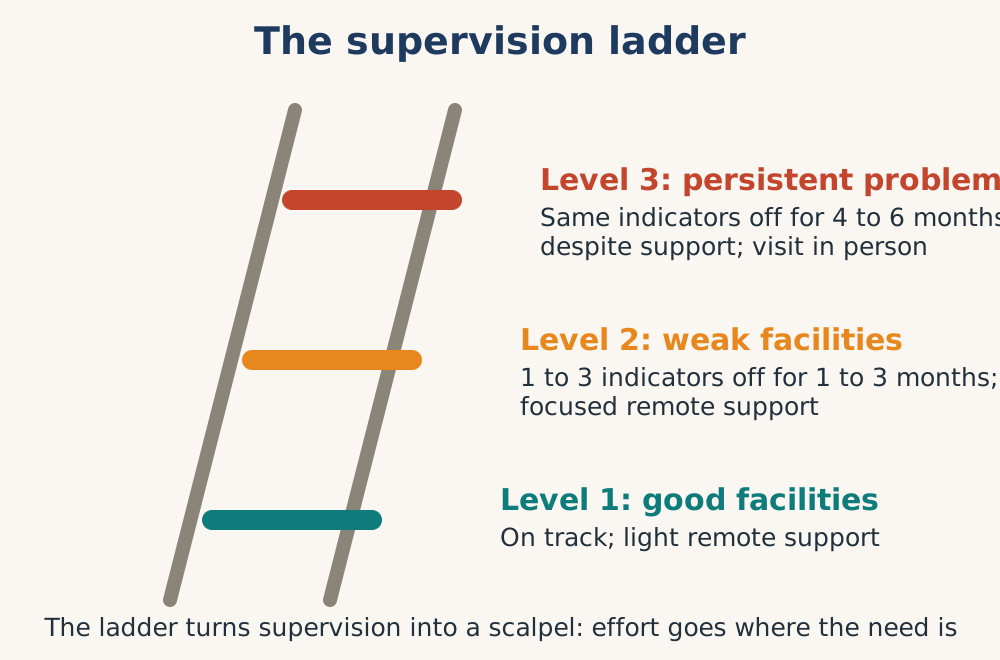
The ladder turns supervision into a scalpel. It closes the loop between monthly self-assessment, quarterly review, and annual planning. That is stewardship. That is how feedback becomes the ultimate form of learning.
The long-term benefits of stewardship to your RHIS
If you implement these actions faithfully, here is what you will gain, not next year, but within six to twelve months.
Sustainability. When the district coordinator is promoted, the new person does not find a mess of disconnected forms. They find a rhythm, monthly self-assessments, quarterly reviews, targeted supervision, a district action plan. They can run it on day one.
Local ownership. Facilities stop reporting to the district and start reporting to themselves. They fix their own stockouts, investigate their own drops in coverage, and celebrate their own wins. The district becomes a coach, not a policeman.
Better data quality, through use. The best way to improve data quality is not more training or more supervision; it is using the data. When a nurse knows her malaria numbers will be discussed at next week’s self-assessment, she pays attention to the register today.
Reduced burden. You stop collecting 50 indicators that no one uses. You stop printing 50-page quarterly reports. You stop supervisors wasting fuel on routine visits that change nothing. The five actions focus on what matters and cut the rest.
A culture of curiosity, not blame. When a facility fails, the question is “what can we learn?” not “who is to blame?” When a facility succeeds, the question is “what did they do right, and how can others copy it?” That is the learning district. That is the RHIS that serves the underserved.
And most important of all: information becomes action. A problem identified in the ten indicators becomes a problem solved, or at least a problem being worked on. No more shelf-sitting plans. No more mechanical reporting. No more supervision that changes nothing.
Now, here are the five actions. They are simple. They are not easy to implement. But they work.
The five stewardship actions: Overview
Once the DHMT information team has made the decision to act as stewards, has prepared for implementation and planned the change approach, the team will drive five high-level actions.
Important: Detailed step-by-step instructions for each action are in Chapter 9, here we focus on the stewardship mindset.
First, curate the action indicators, extract from the national annual plan the action indicators that matter locally using the RAVES criteria (Reliable, Agreed, Valid, Easy, Sensitive/Specific). Negotiate changes with facilities once a year; do not change them monthly.
Second, enable monthly self-assessment by providing simple templates, reminding, supporting, and troubleshooting, do not inspect, empower.
Third, run quarterly progress reviews that bring facilities together to look at the same action indicators, celebrate successes, and solve district-wide problems.
Fourth, practice targeted supervision by monitoring remotely first, using the supervision ladder (see Section 8.8), and only getting on the transport when remote support fails.
Fifth, produce a district action plan that translates the Action Indicators into concrete actions with names and deadlines, one page per indicator, reviewed quarterly.
These stewardship actions are not theoretical. They are the daily, weekly, monthly muscle movements that make governance work.
8.4 Change management: Introducing the five actions without breaking everything
You know the resistance already. “We have no time.” “No budget.” “The national office will never accept this.” Facilities are tired, supervisors are overworked, and the last thing anyone wants is another top-down initiative. So do not announce a revolution. Start with a quiet pilot plot.
Here are the principles of change for stewardship (and for most other things in life too).
Start small, one facility, one indicator, one PDSA cycle, and let success be your sales pitch.
Pluck the low hanging fruit first, the easy wins from simple actions, the visible improvements, the small things that make a big difference to people's life
Do not ask for permission; you are not changing the national plan, only using existing data better.
Use peer pressure, not orders: when a well-performing facility presents its story at the quarterly review, others will want to copy them.
Create early wins: if a facility fixes a stockout in two weeks using PDSA, celebrate it loudly, send a WhatsApp message to all facilities that says “Look what Clinic X did!”
Manage upwards by giving the provincial director and programme managers a simple before-after chart from the pilot, one page of action narrative with no jargon.
And protect your information team; they will be pulled into other duties, so fight for their protected time, materials and funds.
Now use a three-phase change roadmap.
Phase 1 (Month 1), run a self-assessment at the pilot facility, learn what breaks, adjust the template, and train the information team.
Phase 2 (Months 2 to 3), roll out self-assessment to all facilities, run the first quarterly progress review, and introduce remote supervision check-ins.
Phase 3 (Months 4 to 6), launch the full targeted supervision ladder, produce the first district action plan, and begin PDSA reporting from all facilities.
The team needs to anticipate common objections that will inevitably arise.
When someone says “We have no time,” explain that self-assessment replaces endless unused reporting and saves time in the long run.
When they say “No budget,” start with paper, a whiteboard, and a phone, snacks come later.
When they worry “The national office will never accept this,” remind them that you are using the same national indicators, just locally relevant ones first.
And when they say “Our staff are not skilled enough,” answer that this is exactly why you start with one facility, they will learn by doing, and you will learn with them.
8.5 Monitoring stewardship itself: Is it working?
You can have beautiful stewardship policies and enthusiastic staff. But without monitoring the system itself, you will never know if your stewardship system is actually functioning. The question is not about clinical outcomes, those come later. The question is about the stewardship process itself.
Keep a simple one-page stewardship dashboard for the DHMT, not for facilities. Update it monthly and use it in your own information team meetings to ask “Where are we failing as stewards?”
| Indicator | Target |
|---|---|
| Percentage of facilities that completed a self-assessment this month | >80% |
| Percentage of facilities that submitted a PDSA report | >70% |
| Average time from identifying a problem indicator to drafting a PDSA plan | <1 week |
| Percentage of facilities (level 2) receiving remote supervision, with check-ins documented | 100% |
| Number of Level 3 (persistent problem) visits conducted vs. planned | >90% |
| District action plan, percentage of actions updated quarterly | 100% |
For example, a row might show self-assessment completion at 12 out of 15 facilities this month (80 percent) versus 10 out of 15 last month (67 percent), an improving trend.
The ultimate test of stewardship sustainability is not a number. It is a question: when the district coordinator gets promoted and a new person arrives, do they inherit a working system, or a mess of disconnected forms? If the new person can run the cycle on day one, your stewardship is sustainable. If not, keep working.
8.6 Stewardship: Strategies to put the information cycle to work
You have learned a lot in previous chapters. The information cycle (collect, visualise, analyse, tell stories, act). DART: decentralised, action-oriented, responsive, transparent. PRISM: technology, behaviour, organisation. KISS technology, keep it simple, stupid. The virtuous cycle of using minimum quality data to increase demand and local ownership. And most of all, the power of small PDSA cycles to turn data into action.
Now it is time to use all of that to make it all real, through stewardship . Before you dive into the five practical actions in Chapter 9, take a breath. This section is your motivational launch pad. It shows how to take everything you have learned and apply it, using existing resources, changing the way you meet, and building an information culture of curiosity and learning.
Strategy 1: Apply the principles you already know
You do not need new tools. You need to use the ones you have, with a new mindset.
DART means your system must be decentralised (decisions at district, not at national level), action-oriented (every number leads to a next step), responsive (feedback flows back to facilities), and transparent (everyone sees the same data). Ask yourself: does our current system feel like DART? If not, the five actions in Chapter 9 will get you there.
PRISM reminds you that data systems fail not because of technology alone, but because of human behaviour and organisation management factors. A new tablet will not fix a culture of blame. The five actions focus on changing how people meet, how they talk about data, and how they support each other.
PDSA provides a practical way to implement activities, one step at a time, learning by doing, improving by studying and documenting the process.
KISS, Keep information systems simple, short. Ten indicators. One-page reports. short meetings. A phone call for remote supervision. If it feels complicated, you are doing it wrong.
Fruit District example: They used to have a 50-indicator dashboard that no one looked at. They replaced it with ten action indicators on a single whiteboard. That is DART and KISS and can be used for a PDSA.
Strategy 2: Promote the virtuous cycle
The virtuous cycle works like this: when you use a small amount of good-quality data to make a local decision, demand for more data increases. Staff start asking “what else can we measure?” Ownership grows. Stakeholders want to be involved.
You do not need to convince anyone with a PowerPoint. You need to create a small win. Pick one indicator at one facility. Run one self-assessment. Fix one problem with a PDSA. When that facility celebrates its success, others will ask “how did you do that?” That is demand. That is the virtuous cycle.
Fruit District example: Mango Clinic fixed a stockout in two weeks using a PDSA. The district sent all facilities a WhatsApp message: “Look what Mango did!” Three other facilities called the next day asking how to start self-assessments.
Strategy 3: Use existing resources differently
You do not need new staff or money to do stewardship. You need to repurpose, re-use, recycle, and redeploy what you already have.
Empower human resources: You already have passionate people, the nurse who loves numbers, the cleaner who is good with computers, the data clerk who never gets listened to. Form small information teams and develop them. Give them protected time (two hours a week). Stop pulling them into other meetings.
Restructure existing meetings: You already have monthly facility meetings and quarterly district meetings. Do not add new meetings. Change the agenda. Replace administrative trivia with the ten indicators. Replace monologue lectures with deep dive discussions. Replace box-checking with PDSA.
Simplify existing systems: You have forms that collect 50 items no one uses. Stop collecting them. (Yes, you can.) Focus on the ten indicators. Your staff will thank you.
Redeploy available money: Small things make a big difference, internet bundles, transport, paper, drawing paper, snacks. If you have no budget, start with a whiteboard and a phone. The five actions should cost almost nothing extra.
Fruit District example: They stopped printing the 50-page quarterly report. Instead, they put the ten indicators on one page each and used the saved money to buy biscuits for self-assessment meetings.
Strategy 4: Take action: Visualising, interpreting, and finding stories
Data do not speak for themselves. You must visualise them (a simple line graph is fine), interpret them (what does this number mean?), and find the story (why did it go up? why did it go down?).
When your action indicators identify problems, bring in problem-solving indicators (supplementary data) to understand the root cause using “But Why?” technique. Then do multiple small PDSA cycles, not one big, scary reform. Each PDSA is a tiny experiment. You will fail sometimes. That is learning.
Fruit District example: Their action indicator “malaria test positivity” was high. They brought in problem-solving indicators: stockout days (high), test kit expiry (none), staffing (adequate). The story was about a resupply delay. Their PDSA: change the requisition day from Friday to Monday. It worked. Next PDSA: add a phone reminder.
Strategy 5: Build an integrated district-wide stewardship plan
Now bring it all together. The five actions in Chapter 9 are not separate projects. They are a single, organic, integrated cycle using the same ten action indicators for everything:
Weekly data huddles (15 minutes), look at the one indicator that is most off. Quick PDSA adjustment.
Monthly facility self-assessments (2.5 hours), overview, deep dive, PDSA, feedback.
Quarterly indicator reviews (3 to 4 hours), district + facilities together. Deep dive on a district-wide problem.
Targeted supervision, remote at first, then in-person only for persistent problems.
Annual planning, review the ten indicators, negotiate new targets, adjust the list.
This is not a checklist. It is a rhythm. Once the rhythm is set, it runs itself.
The ultimate goal: A culture of information and learning
When all of this works, you will have built something bigger than a set of actions. You will have built a culture, where data are used with curiosity, not fear. Where innovation is welcomed. Where the question is always “what can we learn?” not “who is to blame?”
And because you are using epidemiological thinking to see where the needs are greatest, you will naturally serve the underserved, the catchment areas with the worst indicators, the facilities that have been ignored, the communities that need the most help.
That is stewardship. That is learning. That is the district you are about to build.
8.7 Transition to Chapter 9: The practical cycle
You now have the what, the why, and the how to implement and monitor stewardship itself. You have a change management plan, and you know how to prepare. But stewardship is not just philosophy, it is action.
Chapter 9 gives you the detailed agendas, templates, PDSA worksheets, and step-by-step protocols for monthly self-assessment meetings, quarterly progress reviews, PDSA deep dives (from hypothesis to action), the targeted supervision visit protocol (only when remote fails), the district action plan (one page per indicator), and a 90-day checklist to start from zero.
Turn the page. The muscle is about to meet the road.
References
- Aqil, 2009
- Kawakyu, 2023
- World Health Organization, 2023
- Avan, 2016
- Efoulan Health District study, 2026
- World Health Organization, n.d.
- MEASURE Evaluation, n.d.
- Scoping review, 2023
- Tanzania audit-by-issue study, 2026
- World Health Organization, n.d.