Information for Action
The double loop
Chapter 10 · Building Learning Health Systems
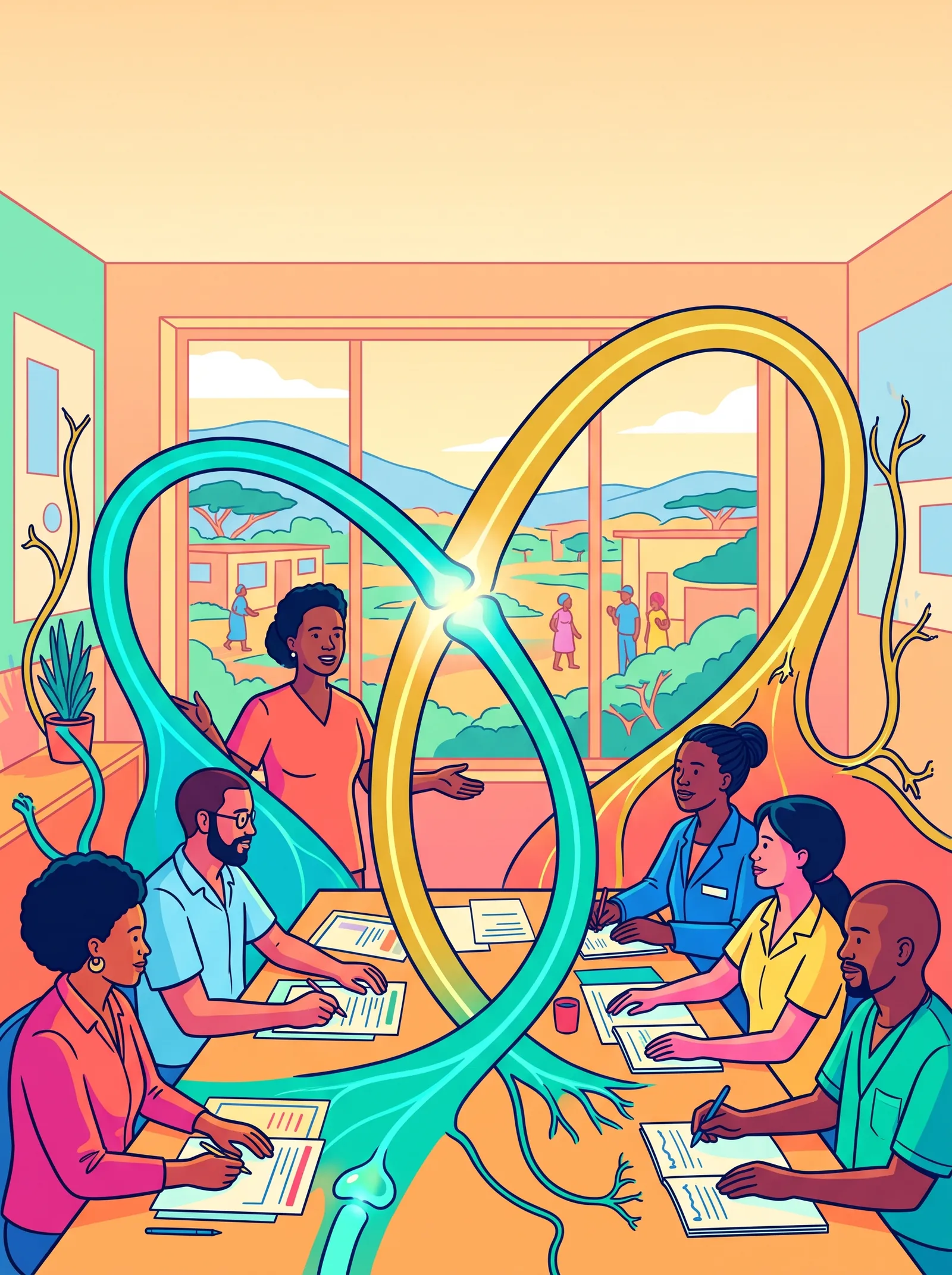
Building a learning district: the double loop that lets a system improve itself.
By the time you have read this chapter, you will be able to:
- Distinguish between compliance-driven data routines and learning-driven stewardship activities, and identify which of your current meetings fall into each category.
- Apply the deep dive + PDSA methodology to a persistent problem in your district, using visualisations, background indicators, and a testable hypothesis.
- Facilitate a quarterly progress review that produces double-loop learning, including the moment when a team questions whether the wrong indicator is being measured.
- Design the five one-page documents (narrative report, deep dive report, PDSA folder, supervision report, feedback file) for your own facility or district.
- Recognise the difference between single-loop learning (fixing within existing rules) and double-loop learning (changing the rules or indicators themselves), and surface at least one double-loop insight from your own experience.
- Build a weekly and monthly rhythm of team learning that continues functioning when champions leave, donors exit, or the national system fails.
10.1 Why a learning district matters
Most health workers collect data they never see again. They spend hours entering numbers into registers, then more hours punching into computers, and still nothing happens. The data disappears into a national server, and the next month they do it all over again. This is not their fault. The system was designed for compliance, not for learning.
But it does not have to be this way.
Imagine a different kind of district. In this district, a nurse draws a simple chart on a piece of paper and tapes it to the wall. The whole team gathers around it. They notice something surprising: Every time there is a stockout, immunisation drops sharply. They ask why. Someone reminds them that the vaccine is always ordered when it reaches a critical level of 30%. They test one small change: ordering when it reaches 50%. The next month, the chart shows improvement. The team celebrates. They write down what they learned, discuss with the supervisor and are invited to present their findings at the quarterly progress review. That one-page PDSA document stays in a folder. When a new nurse arrives six months later, she reads the folder and does not have to learn the same lesson again.
This is a learning district. It is not expensive. It does not require new software or foreign experts. It requires only a bit of vision, critical thinking and leadership that stimulates teams to use the stewardship activities they are already doing, monthly self-assessment, quarterly review, supervision, and annual planning, as genuine learning routines instead of empty compliance exercises.
This chapter shows you how.
10.2 The core insight: Stewardship is already happening
Every district already does the core stewardship activities (on paper at least).
Your facility already holds monthly staff meetings where you review data quality.
Your district already holds quarterly reviews where facilities present data.
Your supervisors already conduct visits.
You already write annual plans.
The problem is not that these activities are missing. The problem is that they are designed for compliance and have become mechanical, boring. People go through the motions because someone above them demands a report, not because they expect to learn something.
The proposed shift is simple but profound. Take the same meeting, the same data, the same people, and change the purpose from compliance to learning. Instead of asking "What do we need to report?" ask "What can we learn?" Instead of "Who failed?" ask "What surprised us?" Instead of "Fill out this form" ask "What should we try differently next week?"
This shift costs nothing. It requires no permission. You can start tomorrow.
10.3 Learning by doing
You cannot learn to use data by sitting in a workshop. You learn by gathering around a visualisation with your team and asking simple questions. You learn by visualising, analysing and interpreting your own data, identifying and telling a two-minute story about what the data showed and what surprised you. You learn by listening to another facility presenting their problem and thinking "That sounds like us, maybe their solution would work here." You learn by writing down what you tried and what happened, so you do not forget and so the next person does not start from zero.
This is why the stewardship activities matter. They are not additional work. They are strengthening and improving the existing rhythm of the health system by asking critical questions and learning from them.
Monthly self-assessment is when you look at your data together.
Quarterly review is when you learn from other facilities.
Supervision is when a coach helps you see what you cannot see yourself.
Annual planning is when you decide what problems to work on next year.
Each of these activities can be a dead compliance routine or a living learning opportunity. The choice is yours.
10.3.1 Team learning through stewardship
The purpose of a learning district is not to train individuals. It is to create a continuous, monthly analytical routine where every team member looks at data, gives feedback, acts on what they learn, and documents everything so no learning is lost.
First, teams learn by doing a deep dive and testing a small change.
At the Quarterly Progress Review, the District presents one problematic action indicator and visualises other relevant background indicators over time. They tell a story about what the data show, identify a specific problem, and propose one hypothesis. They then discuss with facilities: “What PDSA could we all test together to address this hypothesis?” Facilities give input, and the team finalises a district-level PDSA plan.
Each facility then presents a problem of their own choosing, one they have already prepared. They show their visualisation, their hypothesis, and the PDSA they have already tested or plan to test. The audience are curious and ask "What surprised us?" “What is the story?” That question is where real learning lives. Peers give immediate feedback through structured questions.Then they decide whether to adopt, adapt, or abandon the change, and you plan the next cycle.
Double-loop moment: At the end of the review, the group pauses to ask a critical question: “Given everything we have seen and heard, are we measuring the right thing?”
A facility might say: “We have been trying to improve ANC first visits (ANC1) for a year, but our story shows ANC4 tells us more about quality. Maybe we should change our action indicator next year.”
Another might add: “Facility delivery rate matters more than ANC attendance in our context. Mothers come for ANC but prefer to deliver at home”
That moment, when a team proposes a better indicator, is double-loop learning. The district agrees to test the new indicator for one quarter by a PDSA in a few facilities. No one changes the national dashboard, the data is still dutifully reported, but the district learns to measure what actually matters.
Deep dive without PDSA is just thinking. PDSA without deep dive is just guessing. Together, they are learning about and questioning the system. Double loop learning
Second, teams learn by telling and hearing stories.
Data alone does not teach. A number on a page has no meaning until someone gives it a story. Stories are what kept our history alive for millenia before we started writing them down.
When your team member stands in front of a chart and says "Here is what we saw, here is what we tried, here is what surprised us, here is what we learned," the whole team learns.
When a facility that was struggling stands up at quarterly review and shows how they solved a problem, they become the teacher. The facilities listening think "If they can do it, maybe we can too."
Stories spread solutions faster than any directive from above.
Every month, a different team member tells their story about the services they deliver.
Every quarter, facilities tell stories to each other. That is how learning becomes contagious.
Third, teams learn by giving and receiving structured feedback.
Most feedback in health systems is either praise or blame, neither of which teaches anything. Praise feels good but does not point to action. Blame shuts down learning entirely.
Structured feedback is different. After a presentation, peers ask three questions:
"What surprised you about what we presented?"
"What would you try differently?"
"What help do you need from us?"
These questions are specific, they focus on the work not the person, and they always point toward action. The person receiving feedback learns something they could not see themselves. The person giving feedback also learns, because to ask a good question, you must listen carefully.
Feedback flows in every direction to close the feedback loop: from peer to peer, from supervisor to facility, from facility to supervisor, from community to facility, from facility back to community. Every piece of feedback is written down in the feedback file.
Fourth, teams learn by writing narrative reports that add context to visuals.
Numbers without context are just noise.
A monthly report should have a narrative and a visual component and answer structured questions about the action indicators: "What visualisation did we look at? What story did our data tell? What did we learn from our deep dive and PDSA?" By writing the answers to the questions, the team is guided to find the meaning behind the data.
Reports are for the facility and stay at the facility, stored electronically and in hard copy (copied to stakeholders for feedback.)
The monthly narrative report gives basic analysis of the action indicators.
The deep dive report tells a story that adds focused learning on one problem.
The PDSA folder captures every experiment.
The supervision report documents joint learning with the supervisor.
The feedback file holds everything from district comments to community suggestions.
Each report is brief (one page) visual (has graphs or maps) and contains a narrative, analysis of the team, the stories from the field and the insights of practical interventions.
Together, these five documents mean that when a staff member transfers or retires, the new person reads the folder and continues. Over twelve months, you have a full year of institutional memory. No dashboard can do that.
The learning rhythm is weekly, monthly, quarterly, not annual.
Every week a “huddle” to catch up on stories
Every month: one deep dive, one PDSA, one narrative report, one deep dive report.
Every supervision visit: one supervision report.
Every quarterly review: PDSA feedback written down and added to the feedback file.
Everyone is involved, DHMT, nurse, driver, CHW, programme manager, supervisor. Everyone gives feedback through stories. Everyone receives feedback. Everything is written down.
That is team learning through stewardship. That is how a district learns, acts, and never forgets.
10.3.2 Single-loop and double-loop learning
Most health system data use is single-loop learning. You look at a number. It is below target. You find the cause, a stockout, a missed supervisory visit, a training gap. You fix it. The number goes up. You stop. You have corrected an error within the existing rules. But you have not changed the rules themselves.
Single-loop learning answers: "How do we do this better?"
Double-loop learning involves critical thinking and asks a harder question: "Why are we doing this at all? What rules or assumptions are we following that might be wrong?"
“Without deviation from the norm there can be no progress”. Frank Zappa
A facility runs a PDSA and discovers that defaulters are not "forgetful", they have moved away. The single-loop response: improve tracing.
The double-loop response: apply critical thinking and question the assumption that default means forgetfulness, change the rule that says "all defaulters get the same follow-up," and design different strategies for different types of default.
Double-loop learning is uncomfortable because it challenges habits. But it is the only kind of learning that changes systems. Stewardship activities can produce both.
A deep dive that asks "What changed at that point?" often stays at single-loop.
A deep dive that asks "Why do we assume this indicator matters? What would we measure if we started over?" begins double-loop learning.
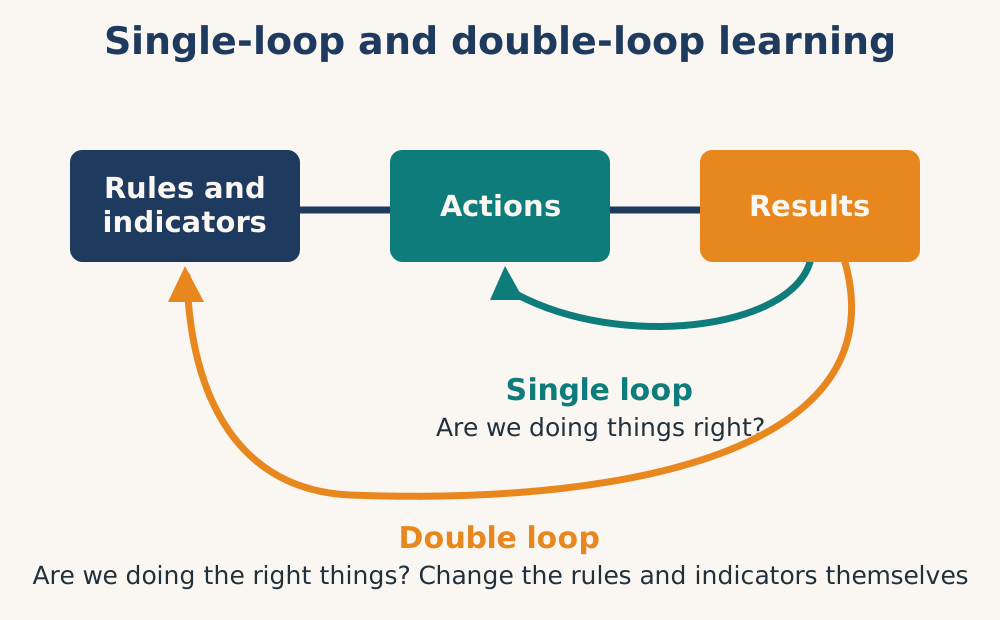
Quarterly reviews that only compare facilities to targets produce single-loop learning. Quarterly reviews that ask "Should we still be using this indicator? What have we learned that makes our old rules obsolete?" produce double-loop learning.
After any problem is "solved" a double loop team thinks critically and asks "If we were wrong about what matters, what would we be doing differently right now?"
10.3.3 What learning looks like in practice
At the weekly data huddle,
The team spends 15 minutes studying a recent issue. The options are endless ...
A supervisor shows a wall chart visualising a problem identified during supervision. She reads the report, The team gives feedback and it is filed for all to access.
The team that tried the PDSA comes with a story: "We predicted X, but Y happened. Here is what surprised us." The team decides whether to adopt, adapt, or abandon the intervention. They document the result in the PDSA folder.
The outreach nurse describes her meeting with the community showing a steep drop in ANC and immunisation caused by a flooded river
At the monthly self-assessment meeting,
After the review of the action indicators, the team gathers around the wall where three visualisations are posted, or looks at the dashboard on the facility computer screen.
The nurse who drew the immunisation chart this month stands in front of it. She says: "What do we notice? What surprises us? What story does this tell? What should we try differently?"
The team spends twenty minutes on a deep dive into one indicator that is not improving. They develop a hypothesis about why. They design one PDSA to test next week. They write the hypothesis in the deep dive report. Before the meeting ends, someone is assigned to try the PDSA and report back.
The MCH programme manager shows the chart for ANC first visits (the action indicator) that is static at 90%. She presents the ANC 4th visit data, thinks that is much more interesting and proposes a PDSA to test changing the core indicator for next year. Double loop learning.
Quarterly progress review
A learning quarterly progress review shifts focus from static compliance to active learning.
Instead of simply comparing facilities to targets, the meeting opens with a question: “What have we learned this quarter?” The district presentation stimulates curiosity
Facilities present their own deep-dive stories, not just data, focusing on what surprised them and what they tested. Peers then give structured feedback.
At the learning market, facility and programme posters display PDSAs and dashboards; Programme managers look for stories for the next quarter’s district learning agenda.
The district closes by asking: “Should we still be using these indicators? What would we measure if we started over?” That double-loop question redesigns the meeting from passive reporting to collective improvement.
District presentation:
Action Indicator Overview (30 minutes) The district opens by displaying the 10 action indicators as a single-page scorecard, not ranked for blame but colour-coded for learning priority: red (stuck), yellow (improving), green (sustained).
A league table is shown but framed by change over time, not static ranking, highlighting which facilities improved most since last quarter, not who is "best."
Deep Dive (60 minutes)
For one selected problem (red) indicator, the district presents
Visualisations, interpretations and stories of the problem solving indicators to the non-performing action indicators.
Findings from supervision (e.g., "Three facilities share stockouts in week three")
Feedback from PDSA folders (e.g., "One facility solved this by doubling week two orders, here is their documented result").
PDSA suggestions: two or three small, testable actions that facilities can adapt next week, not mandates.
A learning question for facilities: "Which of these suggestions have you already tried, and what surprised you?"
Every slide is a visual, no tables of raw numbers, and all feedback is written into the feedback file. The team develops a hypothesis, decides on a PDSA to test and allocates responsibilities. Before the deep dive closes, everyone is clear on what will happen in the next quarter.
- Facility presentation:
Two facilities present (15 minutes each) the results of their deep dive. They show visualisations, They tell their story: beginning (what they thought the problem was), middle (what they tried), end (what they learned).
Peers give feedback using the three structured questions (What surprised you? What would you try differently? What help do you need?)
- Learning Market
This is a learning experience often successfully used at conferences. It takes a bit of preparation and we propose that it should be used to spice up quarterly reviews and promote facility involvement.
At the learning market (one hour), facilities tape posters to the walls. Each poster shows a dashboard, a deep dive result, a PDSA and a learning question. Participants walk around with sticky notes assessing the poster through questions. Green means "We want to try this." Blue means "We tried something similar, here is what we learned."
Programme managers watch which practices spread. Those become the district's learning agenda for next quarter.
10.4 The documents that make learning survive
The greatest threat to learning is staff turnover. Your best nurse transfers. Your facility head retires. Your champion moves to another district. Everything they knew leaves with them. The only defence is written documentation at the facility level.
Each of the following is a one page document written by or with a staff member that answers key questions to promote learning
A monthly narrative report. Answers three simple questions: What visualisation did we look at? What story did our data tell? What did we learn from our deep dive and PDSA?
No numbers required, the charts already have numbers. No format dictated by the district. Plain language that anyone can understand.
A monthly deep dive report. Answers three questions: Which indicator did we dive into and what was our hypothesis? What visualisation did we use? What surprised us when we tested our PDSA? The narrative report tells the broad story.
The deep dive report tells the focused story of one problem you tried to solve.
PDSA documentation. Four boxes: Plan, Do, Study, Act. Plus one sentence: "What we learned that we did not know before."
Link each PDSA to the deep dive report that generated it.
Keep a supervision report. Written together by the supervisor and the facility team. Answers five questions: What visualisation did we look at? What surprised both of us? What change is the facility testing? What help do they need? What did the supervisor learn from this facility?
Supervision becomes a learning conversation, not an inspection.
Keep a feedback file. One place for all feedback coming in and going out.
District feedback from quarterly reviews (written comments, sticky notes from learning markets, priority deep dive topics).
Community feedback from health committees, suggestion boxes, or CHW home visit reports.
Facility feedback sent back to the community (what you changed because of what they told you).
Feedback is only learning if it is written down, responded to, and acted upon.
These five documents together are your facility's institutional memory and should be kept digitally as well as hard copies. When a new person arrives, you hand them the folder. You say: "Read this. That is how we learn here."
10.5 What district managers can do starting tomorrow
You do not need a budget. You do not need permission. You do not need new software. You need only curiosity, intentionality and protected time to do properly what you are already doing.
Tomorrow, take on your existing monthly facility meetings. In the first thirty minutes, put one visualisation on the wall. It can be hand-drawn on a piece of paper or a simple computer projection. Ask your team: "What surprises us?" “What stories are worth telling?” “What can we do about it?”
This week, pick one indicator that is not improving. Draw its trend over the last six months. Look at other related indicators. Ask your relevant programme team: "What changed at that point?" Develop one hypothesis. Write it on one page. That is your first deep dive report.
This month, design one PDSA to test your hypothesis. Try it for one week. Write what happened. That is your first PDSA documentation. Then write a one-page narrative report answering: "What did our team learn from data this month?"
Next quarter, at your quarterly review, put posters on the wall, one per facility showing a deep dive and PDSA. Give each person three sticky notes. Ask them to write one learning or one question on each note and stick it on the posters.
Do not add new meetings. Do not create new committees. Do not wait for formal training. Start with what you have, where you are, tomorrow (or even better, Today!).
10.6 The promise of a learning district
A learning district does not depend on champions, though they are an important part of the start up. When a champion leaves, learning stops. A learning district depends on institutionalised stewardship routines and written memory.
The monthly self-assessment happens because it is on the calendar, not because a particular person drives it.
The PDSA folder is available in the drawer for instant reference.
The supervision file contains reports from remote and in-person supervision
The feedback file is there to see how the different levels see the problems.
The annual action plan is available at every facility and referred to monthly
The new facility head reads the last six months of narrative reports and knows what problems the team has already tried to solve.
A learning district does not depend on donors. When donor funding ends, most projects die. But a learning district
allocates its own scarce resources to support stewardship actions,
uses free open source software and WhatsApp because those do not require expensive software or ongoing contracts.
The learning market uses sticky notes.
The deep dive report is one page.
The PDSA folder is a manila folder in a filing cabinet.
The supervision report is an ongoing living document referred to each month to decide where to do supervision.
A learning district does not depend on the national health information system. When DHIS2 changes or the internet fails, the facility keeps its wall charts around which to tell stories. They keep their PDSA folder. They keep meeting every month to look at data together. The national system can take as long as it takes. The district learns anyway.
This is not idealism. This is happening in districts right now. They started exactly where you are: with a piece of paper, a wall, a team, and a curiosity question. "What surprises us?"
10.7 Distance learning: Building long-term capacity through academic partnerships
The previous section described how technology can help teams stay connected. But informal WhatsApp groups and voice notes, while useful, are not enough to build the deep analytical skills a learning district requires. Real capacity, the kind that earns a qualification, transfers when a staff member is promoted, and stands up to external scrutiny, comes from structured, accredited learning.
This section describes a formal approach: District Health Management Teams (DHMTs) (or provinces, or even national level) partnering with universities to integrate accredited distance learning courses into the stewardship activities you are already doing.
The core insight: Your stewardship routines are university-ready
The deep dive report you already write each month is a data analysis assignment.
The PDSA folder you already keep is a quality improvement portfolio.
The quarterly review presentation you already give is a case study.
The only thing missing is academic credit and structured feedback from a qualified instructor.
The proposed shift is simple but transformative. Instead of seeing university distance learning as something separate from district work, treat your stewardship activities as the practical laboratory for formal coursework. The DHMT becomes a field site. The monthly self-assessment becomes a tutorial. The quarterly review becomes a peer-assessment session. The supervisor becomes a clinical facilitator.
This shift requires no new software. It requires only a memorandum of understanding with one or more universities, and the intentionality to align what you are already doing with their learning outcomes.
10.7.1 How the DHMT creates the bridge
The DHMT's role is not to deliver university teaching. It is to create the conditions for staff to succeed in university courses while continuing to do their jobs.
Step 1: Scan and select
Identify two or three distance learning programmes whose learning outcomes match your district's capacity gaps. Prioritise programmes that:
Offer modular, self-paced learning that respects the unpredictability of district work
Provide academic credit that accumulates toward a recognised qualification (certificate, diploma, degree)
Accept workplace-based assignments as a form of assessment
Have experience with learners in low-resource or remote settings
Are affordable, or for which you can negotiate a group discount or donor sponsorship
Create a one-page matrix. List each programme. Next to it, write: (a) the specific skills it teaches, (b) the time commitment per week, (c) the cost, (d) the entry requirements, and (e) how those skills map directly to your stewardship activities.
Step 2: Broker access
The DHMT uses its convening power to negotiate with universities on behalf of its staff. You can:
Request a group enrolment rate (10 or more staff from one district)
Ask for an extended submission deadline for assignments that aligns with the district's quarterly review cycle
Propose that one assignment be the facility's deep dive report or PDSA documentation, already being produced
Request that the university provides the DHMT with anonymised aggregate performance data, so you can see which modules produce the strongest learning gains
Negotiate a memorandum of understanding that recognises the DHMT as an accredited field placement site
Example: An internet search produced the following for South African institutions offering a diploma in Public Health:
University of Pretoria (UP): Offers a fully online, 2-year PGDip in Public Health (UPOnline) geared towards working professionals with multiple start dates per year.
University of the Western Cape (UWC): Features an NQF Level 8 PGDip in Public Health focusing on district health services and primary healthcare.
University of the Witwatersrand (Wits): Provides a rigorous PGDip Public Health tailored for medical and health sciences degree holders.
University of South Africa (Unisa): Offers a 120-credit Postgraduate Diploma in Public Health (90161) covering infectious diseases, population trends, and health measurement.
Step 3: Integrate coursework into stewardship rhythms
This is the decisive step, where formal distance learning and daily stewardship become a single system.
| Stewardship Activity | How It Supports Formal Distance Learning |
|---|---|
| Weekly data huddle | Staff working on the same university module use 10 minutes to compare notes on an assignment. The facility head asks: "What concept from your course helped you understand our data this week?" |
| Monthly self- assessment | The deep dive becomes the data analysis assignment for the module. The facility submits the same report to the district and to the university. The hypothesis becomes the basis for the module's required project. |
| Supervision visit | The supervisor does not inspect. The supervisor coaches on the course material. She asks: "What is your module asking you to learn this month? Show me how you are applying it to your PDSA." She documents this in the supervision report, which becomes evidence of supervised practice for the university. |
| Quarterly progress review | The district dedicates 30 minutes to a "learning showcase." Two staff members present their course assignments, a data visualisation, an epidemiological analysis, a quality improvement plan, to their peers. Peers give structured feedback. The district coordinator writes a brief verification letter confirming the presentation, which the staff member submits to the university for credit. |
| Feedback file | The feedback file now includes written comments from the university tutor on submitted assignments. Those comments become part of the facility's institutional memory. |
| Annual planning workshop | Each staff member writes one paragraph: "What did I learn from my course this year that will change how our district works next year?" The district synthesises these into the annual learning agenda. |
10.7.2 The long-term capacity that distance learning builds
When a staff member completes an accredited course, even a single module, they carry that credential for life. It is portable. It is recognised. It appears on their CV when they apply for promotion or transfer. That is the fundamental difference between informal learning and formal distance learning.
Portable competence. A nurse who completes a Public Health Epidemiology module owns that knowledge wherever she goes. She does not leave it behind when she transfers. She brings it to her next facility. Over time, the entire district's baseline competence rises because people move through with accredited skills.
Motivation and retention. Staff who receive no recognition for their learning eventually stop learning. Staff who earn university credits, certificates, and degrees see a tangible return on their effort. They stay longer. They work harder. They become the district's recruiters: "Come work here, they will help you get a degree."
External validation. Donors and ministries trust university credentials more than internal training certificates. A district that can report "twelve of our facility heads have completed accredited courses in data use and epidemiology" has evidence of capacity that no dashboard can provide.
Sustainability. When donor funding ends, most in-person training stops. But accredited distance learning programmes continue. Universities exist to teach. They are not project-based. A district that has embedded itself as a partner in a university's distance learning programme has built a relationship that outlasts any single funding cycle.
10.7.3 What district managers can do starting tomorrow
You do not need to have all the answers tomorrow. You need to take the first step.
Tomorrow: Open a browser. Search for "Health Information system distance learning Africa" or "health informatics online certificate." or "Public health certificates". Look at three programmes. Write down: (a) cost, (b) entry requirements, (c) assignment structure. Share what you find with your deputy.
This week: Identify the two or three people in your district who are most ready for formal study, the ones with curiosity and critical thinking who already ask "why," who already keep good notes, who already present well at quarterly reviews. Have a conversation with each. Ask: "If we could support you to earn a university credential while doing your current job, what would you want to study?"
This month: Contact the distance learning coordinator at one university, UNISA, Cavendish University Uganda, the University of the Western Cape, or another. Ask three questions: (a) Can our district's stewardship activities count toward assessed assignments? (b) What would a memorandum of understanding between the university and our DHMT look like? (c) Do you have experience with learners in remote, low-resource settings?
Next quarter: Run a pilot. Enrol one staff member in one module of a distance learning programme. Assign them a mentor from the DHMT. At the quarterly review, they present their first assignment. You assess: Did the integration work? What would you change for the second cohort?
10.7.4 The promise of formal distance learning
A learning district that depends only on informal, undocumented learning is a learning district that will never build the deep analytical capacity it needs to solve its hardest problems. When that district's most curious people leave for better opportunities, they take their unaccredited knowledge with them, and nothing remains.
But a learning district that has partnered with one or more universities, that has enrolled its staff in accredited distance learning programmes, that has integrated coursework into its stewardship rhythms, that has turned its monthly self-assessment into a university assignment and its quarterly review into a peer-assessment session, that district is building capacity that lasts.
When those staff members finish their courses, they have credentials, not just experience. When they transfer, the credential transfers with them, and the district gains a reputation as a place where careers are built. When the next generation arrives, they find not just a job but a pathway: "Work here, and the district will help you earn a degree."
This is not idealism. This is already happening in districts that have made the shift from seeing universities as distant institutions to seeing them as strategic partners. The phone call is free. The first step costs only courage. Call a university tomorrow.
Final thought
A learning district is not built by workshops, dashboards, donors or foreign experts. It is built by interested and curious facility teams gathering around quality visualisations, asking epidemiological questions, identifying and telling interesting real life stories and closing the loop by providing feedback to the data collectors. The team is testing one small change at a time, and writing down what they learned, then doing it again next month, and the month after, until learning becomes not an event but the way you work every day.
Optional field exercise: The one-week PDSA
Pick one indicator that has been stuck for at least three months.
Tomorrow morning, gather your team around a hand-drawn chart of that indicator over the last six months.
Ask: "What surprises us?"
Develop one hypothesis.
Design one small change. Test it on five patients or five days or five catchment areas.
Next week, study what happened and tell a story. Write one sentence: "We learned that we did not know before."
Decide whether to adopt, adapt, or abandon. Then do it again the next week. Report back to your quarterly review.
No permission needed. No budget required. Start tomorrow.
References
- Avan, 2016
- Burkina Faso nutrition data study, 2025
- Burkina Faso digital intervention study, 2026
- Malawi HMIS study, 2025
- GAVI, 2026
- Uganda DHIS2-DEMIS pilot, n.d.
- Aqil, 2009
- World Health Organization, 2023
- Scoping review, 2023
- Routine Health Information Network (RHINO), n.d.