Information for Action
About the book
Origins, authors and sources
An updated second edition of a practical manual for using routine health information at district level.
Where it comes from
Information for Action is an updated second edition, building on Arthur Heywood and Jon Rohde's 2001 manual Using Information for Action: a manual for health workers at facility level. It carries that manual's core conviction forward: that the point of health information is not reporting upward, but action and learning close to where care is given.
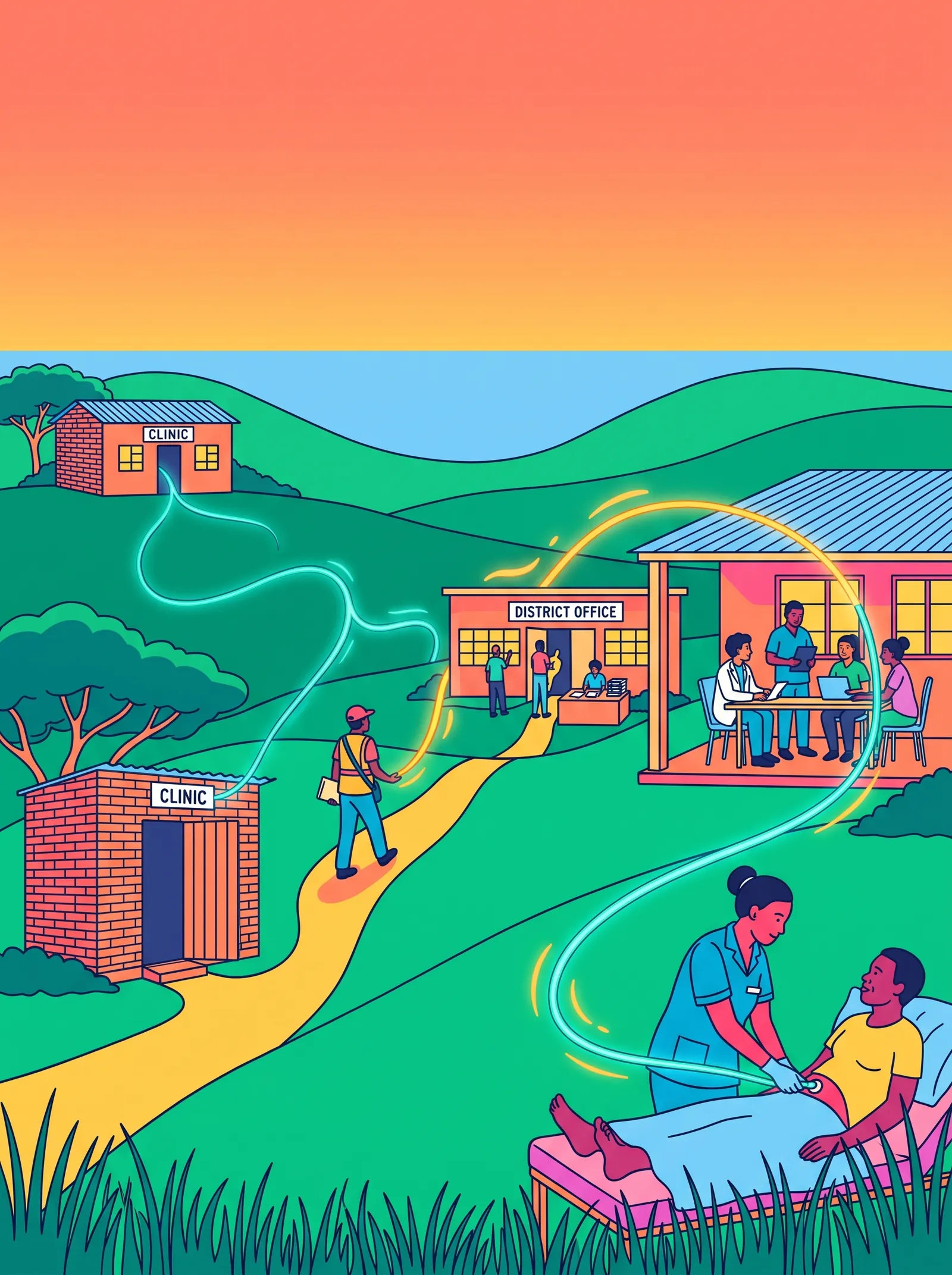
The second edition restructures the material around learning objectives and exercises, adds chapters on visualisation, storytelling, stewardship, planning and digital health, and threads a single metaphor through the whole: the health information system as a living body.
Who it is for
Frontline health managers in primary health care: district health management teams, facility managers and nurses, community health workers, and programme managers. It assumes no specialist training in statistics or software, only a willingness to look at your own data and ask why.
Authorship and credits
Written by Arthur Heywood, Jon Rohde, Norah Stoops, Rudi Thetard and Robin Dyers. Edited, illustrated and laid out by Robin Dyers.
Editorial support for this edition was provided by Claude (Opus and Fable).
How to cite: Heywood A, Rohde J, Stoops N, Thetard R and Dyers R (2026) Information for Action: A Practical Guide to Building Your Learning District, second edition.
Illustrations
The illustrations are by the authors, developed with Gemini (Nano Banana 2) in a consistent flat editorial style, matted so each reads as a framed picture. They may be replaced with local photographs or drawings.
Sources
The foundational sources include Heywood and Rohde's 2001 manual and the health-information-system literature it draws on, including work by Braa and colleagues on developing and improving health information systems in lower-resource settings, and Williamson and colleagues on district health information systems. A full, formatted reference list accompanies the print edition.
Support and thanks
This edition was commissioned by the Western Cape Department of Health and Wellness.
Its development was supported by The Health Foundation and the Knowledge Translation Unit, whose contribution the authors gratefully acknowledge.